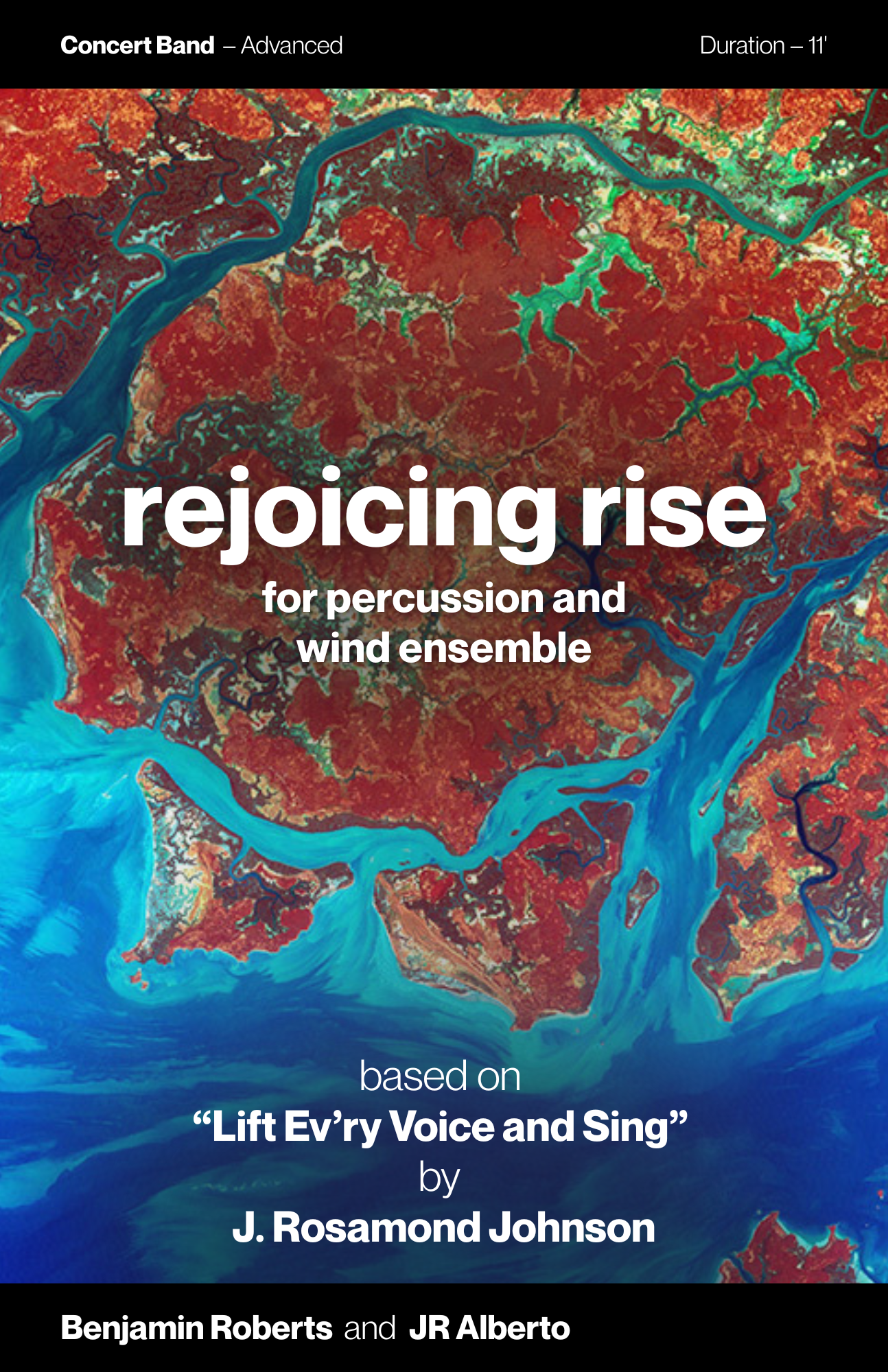
rejoicing rise

$0.00

The music heard in rejoicing rise is derived from African rhythm and African-American harmony. Djembes, dunun, kenken, shekere, and log drums are percussion instruments characteristic to Fula Fare, an improvised style of music and dance from the pastoral Fulani people in West Africa, and the notated rhythms in rejoicing rise approximate patterns idiomatic to this style. One can trace a direct path from these West African percussion idioms to the 12/8 swing feel of African-American hymnody. It is from one such hymn, "Lift Ev'ry Voice and Sing," that rejoicing rise derives its melody, first heard in fragments before the percussion break, and then in full during the marimba cadenza. The text, by James Weldon Johnson, premiered in 1900 as a poem recited by 500 Black students at the segregated Stanton School in Jacksonville, Florida celebrating Abraham Lincoln's birthday. Set to music by his brother, J. Rosamond Johnson, "Lift Ev'ry Voice and Sing" has been embraced across the United States, through the Civil Rights Movement of the 1960s to the present day, as an anthem representing struggle and hope within the Black community.

The music heard in rejoicing rise is derived from African rhythm and African-American harmony. Djembes, dunun, kenken, shekere, and log drums are percussion instruments characteristic to Fula Fare, an improvised style of music and dance from the pastoral Fulani people in West Africa, and the notated rhythms in rejoicing rise approximate patterns idiomatic to this style. One can trace a direct path from these West African percussion idioms to the 12/8 swing feel of African-American hymnody. It is from one such hymn, "Lift Ev'ry Voice and Sing," that rejoicing rise derives its melody, first heard in fragments before the percussion break, and then in full during the marimba cadenza. The text, by James Weldon Johnson, premiered in 1900 as a poem recited by 500 Black students at the segregated Stanton School in Jacksonville, Florida celebrating Abraham Lincoln's birthday. Set to music by his brother, J. Rosamond Johnson, "Lift Ev'ry Voice and Sing" has been embraced across the United States, through the Civil Rights Movement of the 1960s to the present day, as an anthem representing struggle and hope within the Black community.